End-of-day stiffness
Symptoms that build during computer work may reflect sustained loading and reduced movement variability.
West Hollywood · Tech neck & posture
Your screen habits matter—but your posture is more than a reminder to sit up straight.
Forward-head posture, long hours at a laptop, and repeated phone use can contribute to neck, shoulder, and upper-back strain. We measure the pattern and build a correction plan around your actual findings.

Beyond 'sit up straight'
Tech neck is a useful description, but it does not tell us whether symptoms are primarily driven by workload, joint restriction, muscle endurance, cervical curve changes, nerve irritation, or a combination.
Our approach separates what can be changed through environment and exercise from findings that may benefit from chiropractic care or a structured CBP® correction program.
Explore our CBP® structural approachWhat patients often notice
The relationship between symptoms, device use, posture, and recovery helps us determine where to begin.
Symptoms that build during computer work may reflect sustained loading and reduced movement variability.
Photos or posture assessment may show the ear positioned forward relative to the shoulder and trunk.
Muscles around the neck and shoulder blades may fatigue when they repeatedly support a forward position.
These symptoms deserve broader evaluation because posture may not be the only contributing factor.
Your evaluation
Posture assessment is combined with clinical examination so we do not mistake an appearance for a diagnosis.
We look at screen time, desk setup, phone habits, driving, sleep, training, breaks, and symptom timing.
Forward-head position, shoulder and trunk relationships, motion, endurance, and symptom response are assessed.
Orthopedic and neurologic findings help determine whether symptoms extend beyond postural strain.
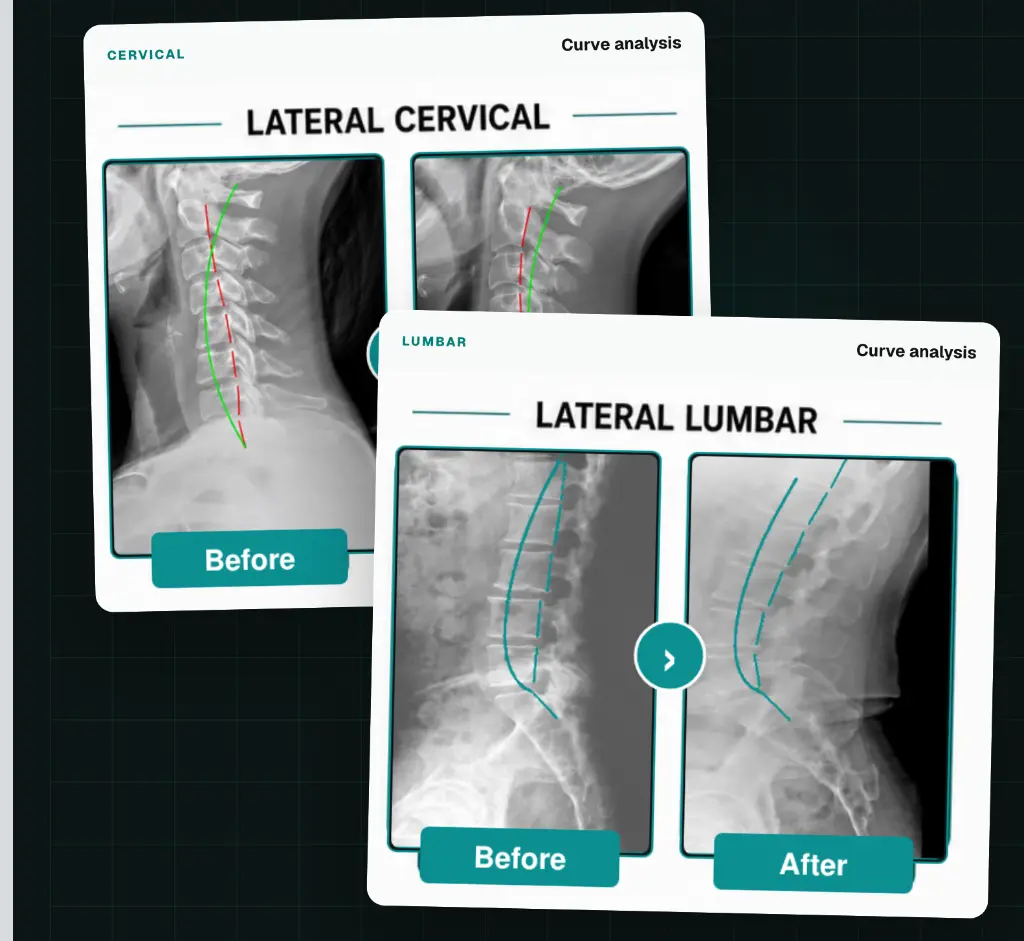
Digital cervical imaging may be considered when curve and alignment information would change the plan.
Personalized care
A durable plan addresses what happens in the clinic and what repeatedly happens during the rest of your week.
Customized traction may be used when objective cervical curve or translation findings support structural correction.
Adjustments may address relevant joint restrictions and support comfortable movement.
Exercises build endurance, control, and movement options for the neck, shoulders, and trunk.
Monitor height, keyboard position, phone use, task rotation, and movement breaks are adapted to real routines.
Objective findings
We can track symptoms and function while also documenting posture or cervical structure when those findings are part of the treatment goal.
Imaging is used only when clinically appropriate. Individual results vary.
Is this the right next step?
A posture-focused assessment can be useful when the problem returns despite stretching, massage, reminders, or changes to your workstation.
Clinical review
This page reflects the evaluation and treatment approach used by Dr. Sam Shirazi, DC and Dr. Ali Pourpezheshege, DC at Back to Total Health West Hollywood.


Common questions
Tech neck is a commonly used description for neck and upper-back symptoms associated with prolonged device use and forward-head posture. A clinical evaluation is still needed to identify the actual contributing factors.
Many postural habits and movement capacities can improve. The potential for structural change depends on the individual findings, tissue adaptability, health history, consistency, and daily environment.
Sometimes habit changes and exercise may be sufficient; in other cases, joint care, corrective traction, or broader rehabilitation may be appropriate. Recommendations depend on the examination.
There is no fixed timeline. Symptom change, endurance, habit change, and measurable structural correction do not always progress at the same rate, so care is reassessed over time.
West Hollywood · Ready when you are
Schedule an evaluation to understand your findings, options, and appropriate next steps.